
Chemical Biology
By utilizing small-molecule compounds that we have independently discovered, we seek to uncover biological functions and responses from new perspectives and to explore their potential as therapeutics for intractable diseases. Our major ongoing projects are as follows.
1. FIT039, a Compound That Suppresses the Expression of Papillomavirus RNA Responsible for Warts and Cervical Cancer
(see also the section on transcriptome-based drug discovery)
FIT039, a CDK9 inhibitor, suppresses the transcription of a broad range of DNA viruses, including papillomaviruses, herpesviruses, and adenoviruses, thereby inhibiting viral replication (Yamamoto et al., J Clin Invest. 2014; Ajiro et al., Clin Cancer Res. 2018).
2. Splicing-Modulating Compounds Applicable to the Treatment of Inherited Disorders: TG003, CANDY, RECTAS, and RECTAS2.0
(see also the section on RNA Biology)
For inherited disorders caused by mutations in splice regulatory regions, splicing-modulating compounds such as TG003 (Nishida et al., Nat Commun. 2011), CANDY (Shibata et al., Cell Chem Biol. 2020), RECTAS (Yoshida et al., Proc Natl Acad Sci U S A. 2015; Ajiro et al., Nat Commun. 2021), and RECTAS2.0 (Awaya et al., Sci Adv. 2025) correct aberrant RNA splicing and exert therapeutic effects.
3. DYRK1A Inhibitors for Down Syndrome: INDY, FINDY, ALGERNON, and ALGERNON2
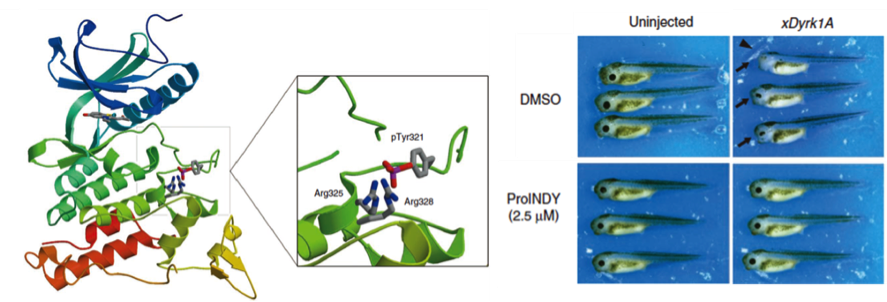
DYRK1A is a kinase essential for brain development and function, and excessive DYRK1A activity is thought to be one of the pathogenic factors in Down syndrome. The development of potent inhibitors that act selectively on DYRK1A is expected to contribute to elucidating the molecular mechanisms of the brain in both healthy individuals and individuals with Down syndrome. We have reported several novel DYRK1A inhibitors, including INDY (Ogawa et al., Nat Commun. 2010), ALGERNON (Kobayashi et al., Proc Natl Acad Sci U S A. 2017), and ALGERNON2 (Kobayashi et al., Sci Adv. 2020; Kobayashi et al., Proc Natl Acad Sci U S A. 2023), and have demonstrated their potential as novel molecularly targeted agents.
http://www.natureasia.com/ja-jp/ncomms/abstracts/34994
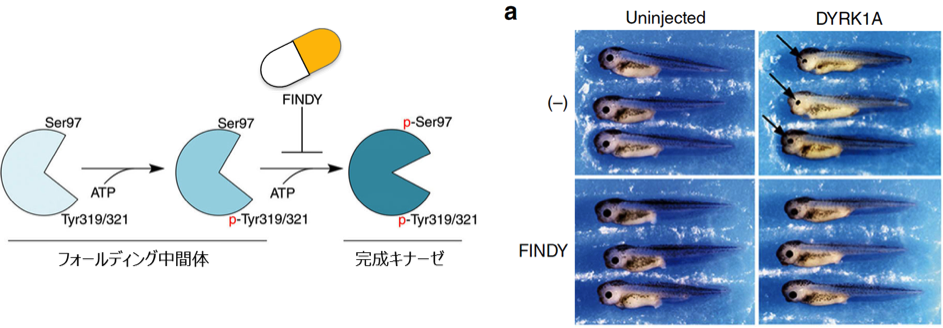
Furthermore, focusing on the fact that kinases regulate their own expression and activity through autophosphorylation, we developed FINDY, an innovative DYRK1A inhibitor that acts on a previously unrecognized intermediate state (Kii et al., Nat Commun. 2016).
http://www.nature.com/articles/ncomms11391
4. ADRIANA, a Non-Opioid Analgesic Compound with a Novel Mechanism of Action
(see also the section on transcriptome-based drug discovery)
ADRIANA, an α2B-adrenergic receptor inhibitory compound, enhances noradrenaline release in the dorsal root ganglion and exhibits potent analgesic effects (Toyomoto et al., Proc Natl Acad Sci U S A. 2025).
5. Induction of Splice Neoantigens by Small Molecules
(see also the section on cancer immunoactivation & suppression of neuroinflammation)
We have also found that the splicing-modulating compound RECTAS not only has therapeutic potential for inherited disorders but also promotes the induction of splice neoantigens, thereby enhancing antitumor immunity (Matsushima et al., Sci Transl Med. 2022).
6. Structural Analysis of S1PR3 Bound by TY52156
We are conducting structural studies of S1PR3, a G protein-coupled receptor (GPCR) that represents an important target for drug discovery (Maeda et al., Sci Adv. 2021; Yamauchi et al., Proc Natl Acad Sci U S A. 2015).